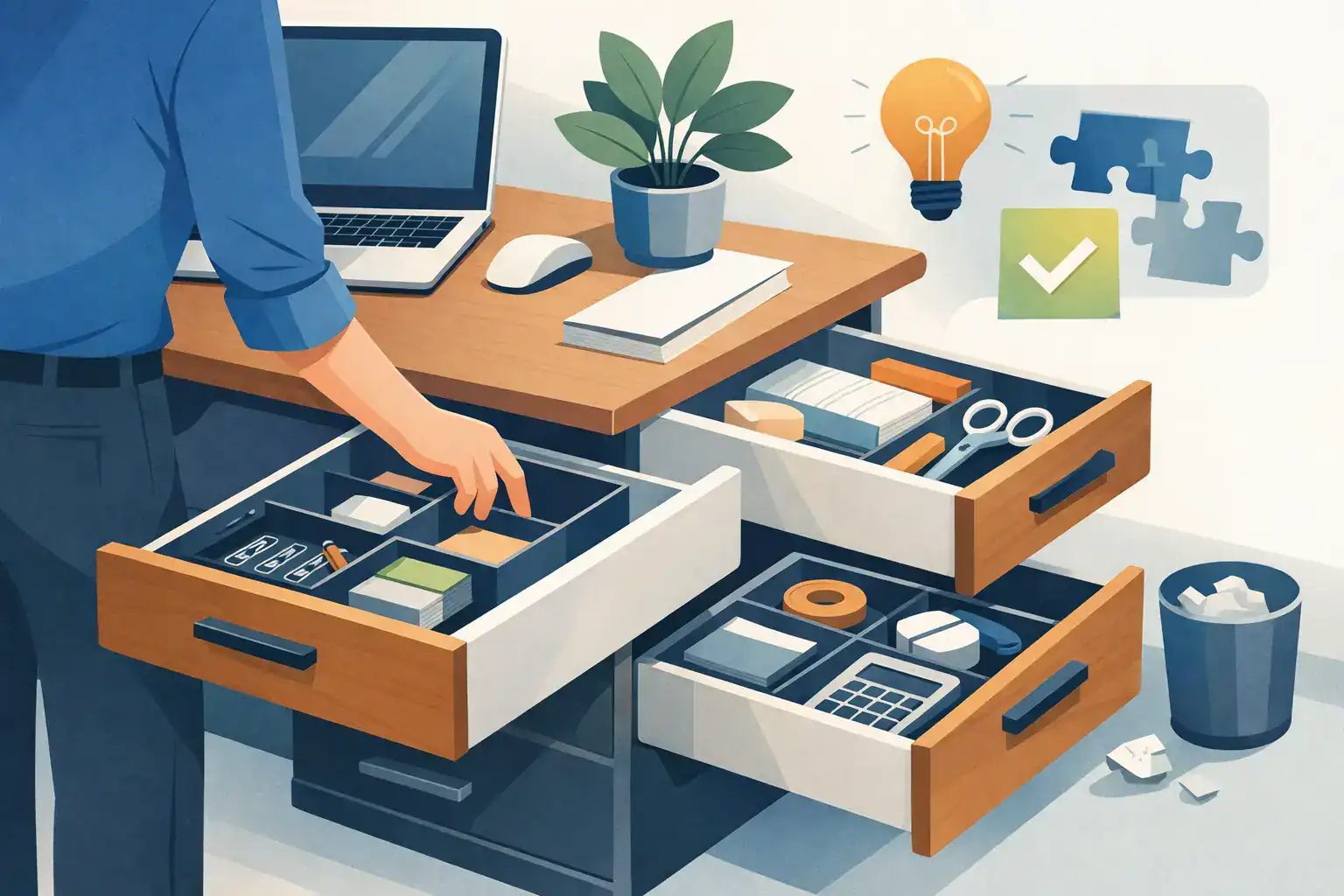
How to Organize Desk Drawers Without Overthinking
A desk drawer can look harmless from the outside, then open to reveal dead pens, mystery keys, tangled chargers, old receipts, and enough paper clips to stock a tiny office. If you are wondering how to organize desk drawers without turning it into an all-day project, start with one goal: make the things you use easy to reach and the things you do not use easy to remove.
A functional drawer is not necessarily an empty or picture-perfect one. It is a drawer that helps you start work, pay a bill, take a class, or handle household paperwork without digging through a pile. The best system is usually simple enough to keep using on a busy Tuesday. That’s the real goal when you learn how to organize desk drawers — not a picture-perfect result, but one you’ll actually keep using.
This post contains affiliate links. As an Amazon Associate, I earn from qualifying purchases at no extra cost to you. See our full disclosure here.
| Product | Best For | Shop |
|---|---|---|
| SpaceAid Bamboo Drawer Dividers | Larger Drawers, Custom Sizing | Check Price |
| Umikk Interlocking Plastic Trays | Shallow Top Drawers | Check Price |
| FYY Electronic Organizer Pouch | Cords & Chargers | Check Price |
| mDesign Stackable Divided Trays | Deep Drawers | Check Price |
| Sooez Expanding File Folder | Active Paperwork | Check Price |
Start by emptying one drawer at a time
Do not dump every desk drawer onto the floor unless you have plenty of time and a clear place to sort it. One drawer at a time is less overwhelming, and it lets you see what that particular drawer actually needs to hold.
Put everything on a nearby table, bed, or clean section of the floor. Wipe out the inside of the drawer while it is empty. Crumbs, dust, and loose staples have a way of making even a newly organized desk feel messy again.
As you sort, make quick decisions. Throw away dried-out pens, duplicate instruction manuals, receipts you no longer need, and broken office supplies. Set aside items that belong elsewhere, such as batteries, beauty products, kitchen scissors, or tools. A desk drawer becomes chaotic when it doubles as storage for every small object in the house.
If paperwork is taking over, pause before buying more organizers. Most desk drawers are a poor long-term home for stacks of documents. Keep only papers that need active attention, such as forms to sign, bills to pay, or notes for a current project. File important records somewhere more secure and easier to browse.
Decide what each desk drawer is for
The easiest way to organize desk drawers is to assign every drawer a clear job. That job should reflect where your desk is and how you actually use it.
A home office desk may need a daily supplies drawer, a technology drawer, and a paperwork drawer. A student desk might need one drawer for writing tools, another for study materials, and a small section for chargers. A family command-center desk may work better with a drawer for mail supplies and another for labels, stamps, and schedules.
The top drawer should usually hold your most-used items. Think pens, sticky notes, scissors, a notepad, headphones, and the charging cable you reach for every day. Lower drawers can hold backup supplies, reference materials, and items you use less often.
Avoid giving a drawer a vague purpose like “miscellaneous.” Some miscellaneous items are unavoidable, but a vague category invites clutter. Instead, create a more useful label in your mind, such as “small tech,” “mail supplies,” or “occasional office tools.” You do not have to physically label every drawer, although labels can help in a shared workspace.
Sort supplies into simple, usable groups
Once you know a drawer’s purpose, group like items together. Keep categories based on function, not on what looks neat in a photo. For example, a pen, highlighter, sticky notes, and index cards can live together if you use them all for planning.
Common desk-drawer categories include:
- Writing supplies, including pens, pencils, markers, erasers, and correction tape
- Paper supplies, including sticky notes, notepads, index cards, stamps, and envelopes
- Small tools, including scissors, a ruler, a tape measure, a stapler, and a staple remover
- Tech essentials, including charging cables, adapters, earbuds, screen cloths, and spare batteries
- Paperwork in progress, including current forms, project notes, and items that need action
You do not need every category. In fact, fewer categories usually work better in a small desk. The point is to stop unrelated items from migrating into the same pile.
Be honest about quantity, too. Keeping three favorite pens is practical. Keeping 27 pens “just in case” makes it harder to find any of them. Place backups in a separate supply bin, closet shelf, or lower drawer. Your active drawer should hold what supports your routine right now.
Choose drawer organizers that fit the drawer and the job
Organizers are helpful only after you declutter and create categories. Buying a set of bins first can leave you with containers that do not fit the drawer or categories that exist only because you bought a container for them.
Measure the inside length, width, and height of the drawer before choosing trays. Drawer sides, center rails, and hardware can reduce usable space, so measure at the narrowest point. Adjustable bamboo dividers are a good choice for larger drawers that hold supplies of different sizes. Interlocking plastic trays work well for shallow top drawers because you can customize the layout and lift out a section for cleaning.
For a deep drawer, use a few larger bins rather than a grid of tiny compartments. Deep drawers can hide supplies under each other, especially chargers and bulky office tools. A small open bin for cables and a separate bin for backup supplies keep those layers from turning into a rummage zone.
There is a trade-off with compartment-heavy organizers. They look tidy, but they can be frustrating if each section is too small for the items you own. Leave a little room for real life. A tray that comfortably holds eight pens is more useful than one that forces you to line up exactly six.
Give cords, paper clips, and other small clutter a boundary
The smallest items are often what make desk drawers feel out of control. Give them a defined container instead of letting them float around the drawer.
Use a zippered pouch, small lidded box, or divided tray for cords and adapters. Coil each cable loosely and secure it with a reusable cable tie or hook-and-loop strap. This takes a few extra seconds up front, but it prevents the knot of chargers that makes you avoid the drawer altogether.
Paper clips, binder clips, push pins, and spare staples need a small cup or compartment. A magnetic tray can work if your drawer stays relatively still, though it is not the best choice for a drawer that gets slammed shut. For loose change, keys, or tiny household odds and ends, use one catchall tray with a firm limit. When it fills up, sort it rather than expanding the category.
Use vertical space carefully in deep desk drawers
Deep drawers can store more, but they can also become black holes. If yours has enough height, consider stacking supplies in shallow, lift-out trays. The top tray can hold daily items, while the bottom layer stores refills or less-used tools.
This approach works best for lightweight supplies such as sticky notes, envelopes, labels, and spare pens. It is less effective for paperwork, which gets bent and forgotten when stacked too high. If documents must live in a deep drawer, use a small file box or hanging file frame so each paper has a visible category.
Keep the bottom of the drawer as open as possible. A drawer that is packed to the top may technically hold more, but it will be harder to maintain. A little breathing room makes it easier to put things back where they belong.
Create a paperwork system that does not clog the drawer
Paper is one of the biggest reasons desk drawers fail. It arrives constantly, often feels too important to toss, and can quickly cover the supplies you actually need.
Set up one active-paper section for items that need a decision or action. Limit it to current tasks, not every piece of mail you have received this month. A slim file folder or an expandable organizer can keep categories separate without turning the drawer into an archive.
Then create a routine for incoming paper. Open mail near a recycling bin. Recycle junk immediately, shred sensitive documents you do not need, and move long-term records to a dedicated file box or cabinet. If you work from home, consider a separate spot for work documents so they do not blend into personal paperwork.
How to Organize Desk Drawers for Good
Once you know how to organize desk drawers, keeping the system going is the easy part. Organizing works best when the system has a low-maintenance finish. At the end of the workday or once a week, take two minutes to return stray items, recycle unneeded notes, and put loose supplies back into their sections.
You will probably still have an occasional drawer that becomes messy during a busy season. That does not mean the system failed. It may mean the drawer needs a different category, a larger tray, or fewer items. Adjusting the setup is more realistic than trying to maintain a perfect arrangement forever.
A well-organized desk drawer should make your next task feel lighter. Keep what supports your day, give the rest a better home, and let the drawer be useful instead of impressive.
About The Storage Society
We’re passionate about turning cluttered spaces into calm, functional ones — one room at a time. Every product we recommend is researched for real usefulness, not just trends. Read more on our About page.